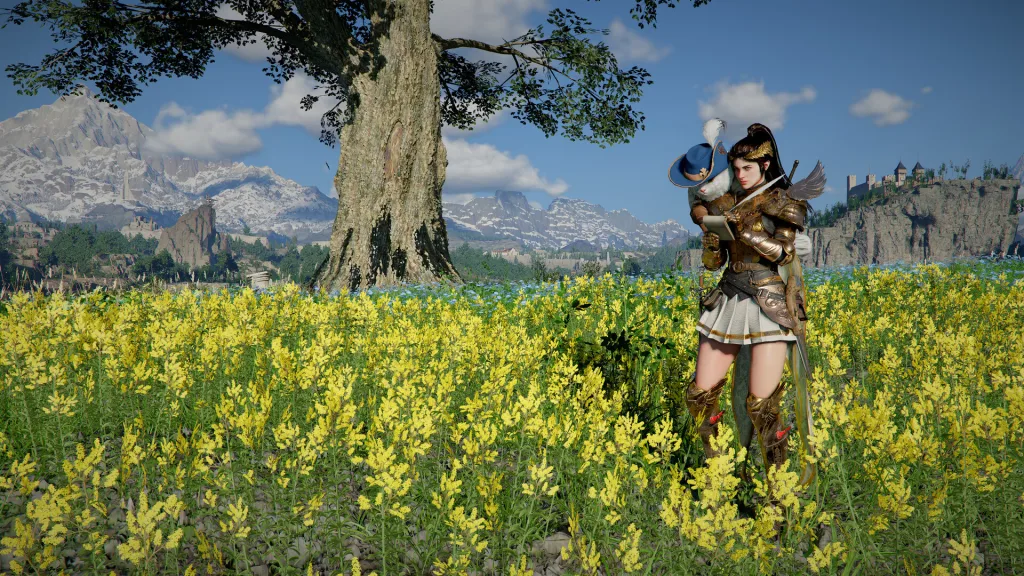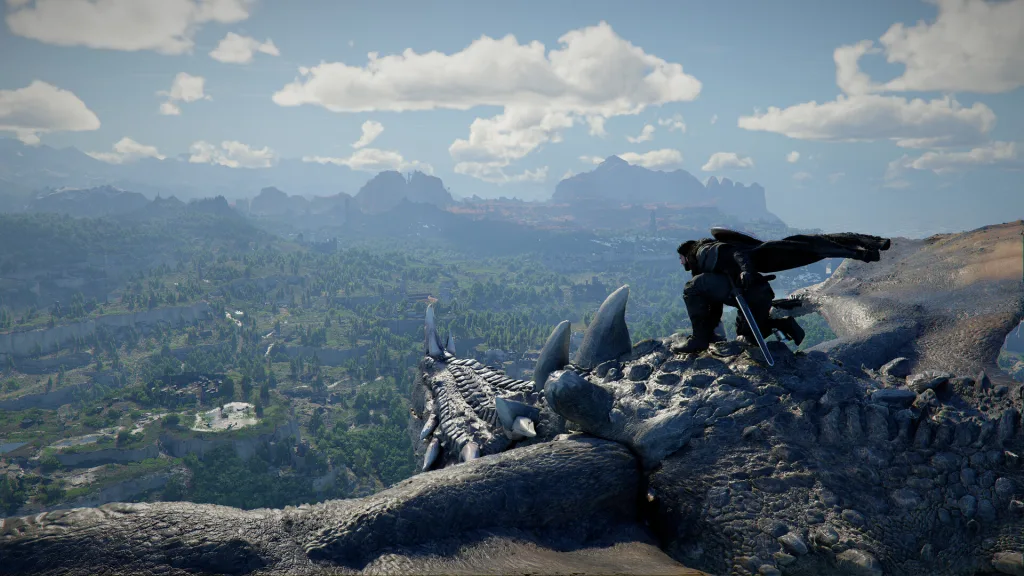
Pearl Abyss explained on 19 November how it built the roughly 200 km² continent of Crimson Desert and how its in-house BlackSpace Engine draws it, in a G-CON 2026 session at BEXCO in Busan, the developer conference held alongside G-STAR. Art level director Ahn Geun-tae and game engine graphics director Yoon Jin-ho gave the talk, according to Daily Hankook’s report from the session. The most detailed account, with the engine figures quoted below, comes from 4Gamer’s write-up; we could not find published slides or a recording on 20 November.
Crimson Desert launched in March 2026 on PC, Mac, PlayStation 5 and Xbox Series X|S (the Steam page gives 19 March), and a day before the talk it took the grand prize at the 2026 Korea Game Awards. Pearl Abyss had already spoken about the game at CEDEC in Yokohama in July and at gamescom dev in Cologne in August. English reports of those sessions covered the production pipeline, such as Houdini-generated rivers and roads and XML-driven scripting (Inven Global on CEDEC), and the general aim of a “playable world” where distant towers can be reached (Inven Global on gamescom dev). The Busan session added the rules and numbers behind that aim.
A forest designed to be read, not to look real
Ahn opened by calling the environment “the narrator that speaks to the player first”, not just a level. 4Gamer reports that the team dropped realism as the goal for vegetation: a dense, accurate forest hid landmarks and made players lose their bearings, so the target became the “most readable forest”. Density is set by purpose. Travel routes keep sightlines open, discovery areas hide the view and then reveal it, combat spaces leave room to move, and quieter stretches are kept plain so the next highlight stands out.
Both reports describe a sample-based workflow. Artists hand-build representative patches of the world, the team extracts rules from them, such as how vegetation thins beside a road or how slope affects what the player can see, and Houdini applies those rules across the continent. According to 4Gamer, this replaced work that had produced uneven quality between regions and between artists, and the time saved went into making more varied samples; improving one sample improves every area built from it.
Landmarks are designed at two scales: strong silhouettes that read from about 1 km away, and ruins and other detail that matter at about 10 m. The team walked test routes to check that what the player sees on the horizon can really be reached. Ahn also described areas that looked good in screenshots but failed in play, where plants hid buildings and collectibles or terrain blocked movement. The lesson, as 4Gamer reports it, was that they had designed for viewers rather than walkers, and that exploration now wins when it conflicts with a pretty shot.
How BlackSpace keeps up to 500,000 trees in a scene
Yoon’s half of the talk covered rendering. 4Gamer lists three distance bands: near (about 1 km), mid (about 3 km) and far (more than 10 km). Terrain is driven by height, normal, region and mask maps; nearby terrain is generated at runtime, while distant terrain uses pre-baked meshes that keep ridgelines intact. Cliffs and complex rock faces use reusable preset meshes.
- Vegetation: the GPU places plants at runtime from density and slope rules instead of storing each plant as a separate object, which would overload the CPU.
- Impostors: distant trees are drawn as simplified images for more than 100 tree types, allowing up to 500,000 trees in a single scene.
- Streaming: objects are split into more than 20,000 “SceneLevel” units by size and position, and only those near the player load. Meshes and textures stream asynchronously, with five LOD steps.
- Frame time: GPU compute for visibility checks, async compute alongside rendering, CPU multithreading and a frame scheduler that orders dependencies to keep frame times stable.
Daily Hankook’s report confirms the outline: data is loaded selectively for a seamless world, and work is split so the GPU handles distance-based rendering and individual vegetation instances.
Lighting, water and grass react to the same inputs
According to 4Gamer, global illumination is fully dynamic, with no baked lighting. It combines hardware ray tracing with software ray marching and uses a surfel-based radiance cache to reduce noise. Froxel-based volumetrics handle light through fog, with two cloud layers at different heights. Water near the player uses a shallow-water simulation with collisions against rocks and ground, while distant rivers use pre-baked flow maps.
A shared fluid simulation field gives every point a flow direction and strength, and vegetation, cloth, fog, dust and particles all read from it. Character movement and weapon swings update the field immediately, so nearby fog and plants respond in the same way. Plants react on three levels: they bend and recover, they can be cut or broken and stay damaged, and branches deform continuously while the player climbs or pulls on them. Daily Hankook describes the same behaviour in plainer terms, with grass that bends underfoot and can be cut by attacks and branches that spring back or snap. Yoon summed up the rule behind both halves of the talk: “Anywhere you can see on screen, you should be able to actually go.”
4Gamer reports that BlackSpace is also being built for Pearl Abyss’s next projects, DokeV and PLAN 8.