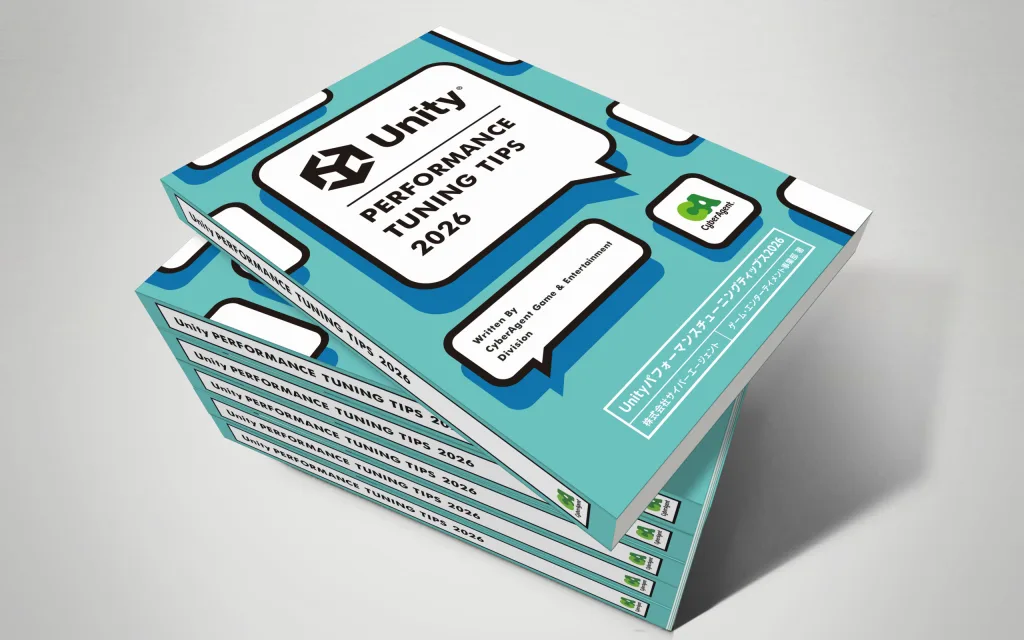
CyberAgent’s Game & Entertainment Division released Unity Performance Tuning Tips 2026 free online on 10 November, a 21-chapter book in which 16 of its engineers report measured results from mobile Unity 6 projects. CyberAgent’s developer blog presents it as the sequel to the Unity Performance Tuning Bible, the company’s free 2022 book, which has about 1,700 stars on GitHub and an official English translation.
The book is a web edition plus a PDF in the project’s GitHub repository. Game Makers puts the Japanese PDF at 378 pages, according to its report. The README lists English, Korean, Simplified Chinese and Traditional Chinese editions, says they were translated by AI and treats the Japanese text as authoritative. It also says no licence is applied but copyright still holds, so the book can be read and used freely, not republished. The introduction adds that the verification used Unity 6 (6000.x), with the exact version stated in each chapter, and that numbers should be read as “what had which effect” rather than as targets.
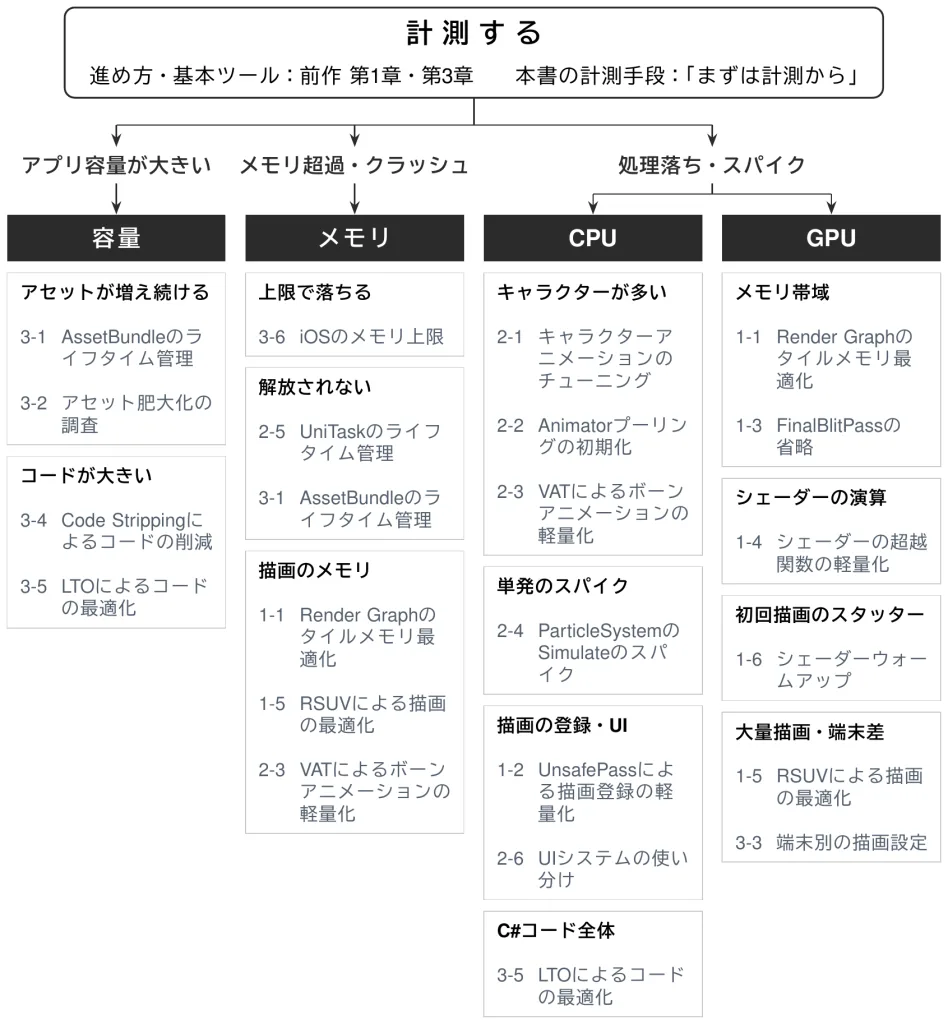
The four parts cover graphics; scripting and animation; assets, settings and builds; and measurement and automation. A reverse-lookup guide at the front sends readers from a symptom, such as app size, memory crashes or CPU and GPU spikes, to the relevant chapter.
ThinLTO pays off on Android, not on iOS
In the link-time optimisation chapter, Kim Minhyuk tested IL2CPP builds on a Pixel 8a with Unity 6000.5. Adding ThinLTO to the Release configuration cut CPU time in a direct-call benchmark by 21.8%. It made the cold build 15% longer (62 to 71 seconds) and libil2cpp.so 2.2% larger. The Master configuration lengthened builds by 39% and grew the library by 18.2%, and ThinLTO accounted for almost all of its speed gain. Full LTO took 3.5 times as long as the baseline on the benchmark. On a real title, linking reached 20 GB of memory and was killed after 2,903 seconds.
Real projects gained less: UnityMain time fell 3.21% on one shipped title. On an iPhone 13 the same benchmark ran 23.77% faster, but a real title showed no clear improvement while its IPA build time rose from 357 to 3,094 seconds, so the team did not adopt it on iOS. The chapter also advises against the engine-code LTO option, because it requires turning off Strip Engine Code, which added about 5.67 MB to the APK and 18 MB of resident memory. Its reminder before changing anything: LTO speeds up only the IL2CPP part of a frame, so a 20% gain on 8 ms of scripting in a 33 ms frame saves about 1.6 ms.
What the iOS memory entitlements buy on 3, 4 and 6 GB iPhones
The iOS memory chapter measured the point at which iPhones killed the app, and stresses that these are measurements, not limits published by Apple. With Apple’s Increased Memory Limit entitlement, a 3 GB iPhone stayed at about 1,850 MB, a 4 GB model rose from about 2,050 to 2,290 MB, and a 6 GB model went from about 3 GB to about 4 GB. The Extended Virtual Addressing entitlement widens address space from 17.375 GB to 63 GB on devices with more than 3 GB of RAM, but adds no RAM. Both need an explicit App ID and a paid developer membership; from Unity 6000.0.11f1 they can be added in a post-build script with ProjectCapabilityManager. The author recommends enabling both and not expecting them to rescue 3 GB devices. He also found that iOS 26.4 reserved about 1 GB of address space for WebKit’s JavaScript engine on a 3 GB iPhone, which fell to 512 MB on iOS 26.6.1.
Render Graph settings that waste tile memory
The Render Graph chapter uses calculated estimates at 1080p and 60 fps rather than device measurements. It lists the URP code patterns that make mobile GPUs write to main memory. A plain Write instead of WriteAll forces a load. Reading an earlier result with UseTexture forces a store and stops passes merging. Compute passes and AddUnsafePass also break merging, and global textures are always stored. Keeping three RGBA8 G-buffer targets in tile memory avoids about 24 MB of writes per frame, roughly 1.4 GB/s. The chapter advises turning off the Depth Texture when no shader reads it and checking the Render Graph Viewer’s pass-break reasons.
The same rules as a skill for coding agents
The last chapter, by Nakamura Teruhisa, turns 163 rules from both books (77 from the Bible, 86 from the new edition) into an Agent Skills package in the repository’s skills/unity-perf-review/ folder. It targets Claude Code, OpenAI Codex, GitHub Copilot and Gemini CLI. A script runs each rule’s grep pattern, the agent reads only the matches and discards false positives, and every finding must cite a rule ID. The checklists take about 10,000 tokens and the full rule set over 40,000, so rules load only when needed. The chapter publishes no accuracy figures and warns that static review also flags settings chosen on purpose, such as an uncompressed texture. It also advises inspecting any skill’s scripts before running it.
Printed copies will be handed out at CyberAgent’s free Game Tech Night event on performance tuning at Abema Towers in Tokyo on 2 December; registration closes on 24 November.
Disclosure: GameTales drafts its articles with AI assistance, including Anthropic’s Claude Code, one of the agents the book’s review skill supports.