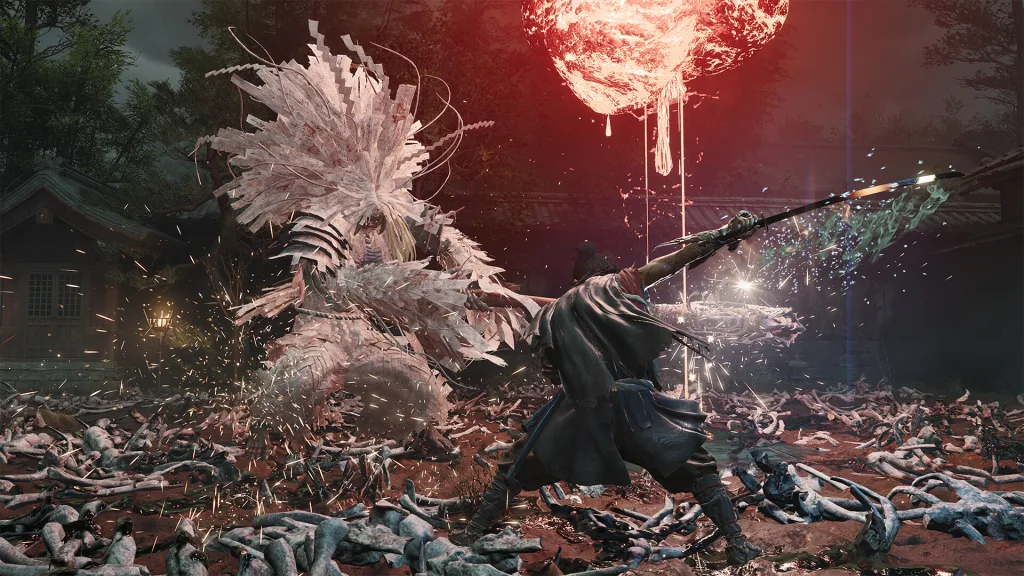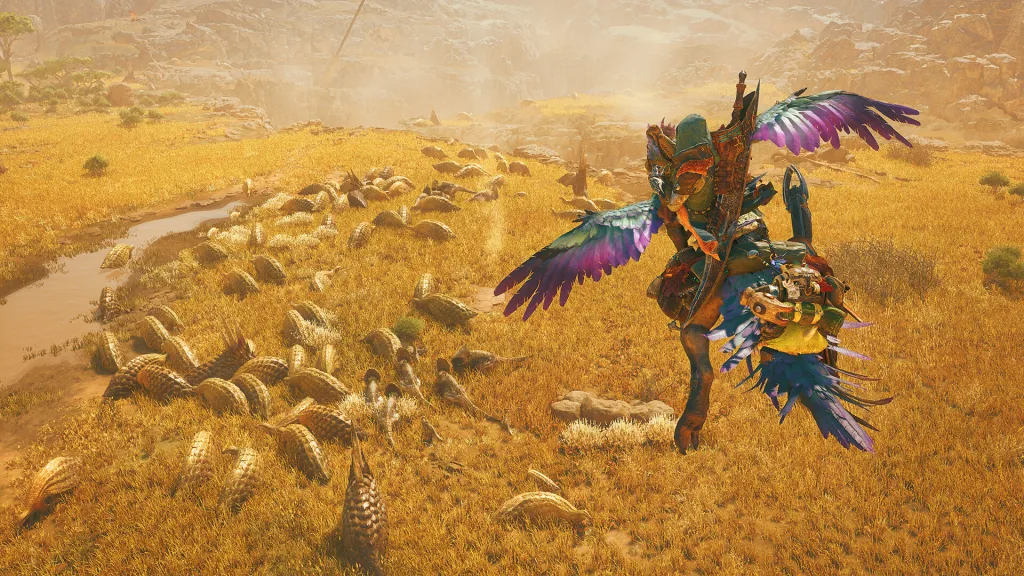
Capcom on 13 November published the slides of a talk on VORTEXEL, the GPU simulation system that drives wind, spreading fire and small debris in the visual effects of Monster Hunter Wilds and Onimusha: Way of the Sword. The deck, posted by Capcom’s R&D account, is from a session by effects programmer Teppei Yoneyama at CAPCOM Open Conference RE:2026 in Tokyo on 2 October, and builds on a talk he gave at CEDEC 2025. Capcom put slides and recordings of seven RE:2026 talks online this week, Game Makers reported.
The name joins voxel and vortex. VORTEXEL is an umbrella for four modules that run volume simulations on voxels and 3D textures: Geometry, which analyses terrain; Turbulence, for wind; Thermal Conductor, for heat and fire; and Physics. Dependencies run one way only, so fire can read the wind and spread faster downwind. Yoneyama joined Capcom in 2013, worked on effects for Monster Hunter: World and Iceborne, and says he first hacked the idea together around the start of Iceborne‘s development, using a 1-bit signed distance field (SDF) built on the CPU.
A voxel copy of the terrain, built over 130 frames
Geometry turns the game’s existing CPU terrain collision into a GPU collision space of 224 by 112 by 224 metres at 0.5-metre voxel precision, so artists need no extra assets or bakes. Triangles are rasterised into a simplified SDF that can let fast objects tunnel through; the slides accept that because effects do not affect gameplay. In Onimusha, rain leaked through thin wooden roofs and walls, and those spots fall back to dynamic box collision. A finer occlusion layer splits each voxel into eight 25-centimetre cells at one bit each for the fluid simulation.
The space is built gradually: by default 1,000 blocks of 3.5 metres per frame and no more than 4,000 triangles, which fills the whole area in about 130 frames. Each triangle is packed into 8 bytes instead of the 36 bytes of three float3 vertices, and a sparse layout replaces a dense 512-cubed grid that would need 134 MB. Geometry ends up at about 65 MB.
Wind that follows the dunes for 0.6 ms on PS5
Turbulence is a real-time 3D fluid simulation with no offline baking. It reacts to terrain, monsters and dynamic collision, covers 128 by 32 by 128 metres by default, and hands over to each game’s existing wind system beyond that. Wind emitters fit in 80 bytes and come as boxes, spheres, cones or cylinders. On PlayStation 5 the module costs about 0.6 ms, running in the background through async compute, and uses about 20 MB of video memory; all modules together stay under 100 MB.
In Wilds the wind moves campfire smoke, cloth, grass and trees, and the deck singles out the sandstorm, where players should feel strong wind tracing the dunes. Late in development the team added a mode that switches the simulation off but keeps emitters and wall occlusion, because simulation is often the first thing cut for performance. “Quality drops, but having the option is what matters,” one slide says.
Fire that runs on timers instead of temperatures
Thermal Conductor was meant to propagate actual temperature, but that proved hard to control, so it became time-based. The slides’ examples: grass that touches fire for one second ignites and burns for two seconds; a fireball sets fire spreading from its impact point for five seconds. Heat sources are linked spheres rather than a 2D heat map, and both CPU and GPU can read how charred something is, which drives burn-away material animation. Wilds uses it for burning grass in the Windward Plains, set up per grass clump, and for the oil fields and tar areas of the Oilwell Basin. Fire was first planned for Monster Hunter: World and shelved.
10,000 debris particles for 0.06 ms
The Physics module handles what Yoneyama calls tiny physics: objects no larger than one SDF voxel, 0.5 metres in the Wilds setup, simulated for speed and control rather than accuracy. Shapes range from spheres and cards to meshes of up to 16 vertices, and colliding particles use spheres. On PS5, 10,000 particles cost 0.06 ms with particle-to-particle collision and 0.03 ms without, while an attack throws off just under 100 fragments. Onimusha uses it for masses of skulls that react to characters; Wilds for pebbles from monster slams, spent light bowgun cartridges, the gunlance’s ejected pile and herbs in campfire cooking.
The guiding rule is what Yoneyama calls “Click to Go”: a feature should work after one click. Artists enable VORTEXEL with a checkbox and add a collision item in the existing effect editor. Even mass is hidden by default, because artists usually express weight through velocity damping. The system also served Monster Hunter Bridge, Capcom’s multi-screen exhibit at Expo 2025 in Osaka, with almost no support from the team.
The same batch of talks covers LOCO, Capcom’s in-house localisation system, and real-time path tracing in Resident Evil Requiem and Pragmata, which Capcom also presented in English at GDC 2026. The games themselves are on Steam: Monster Hunter Wilds since February 2025 and Onimusha: Way of the Sword since 3 September 2026.