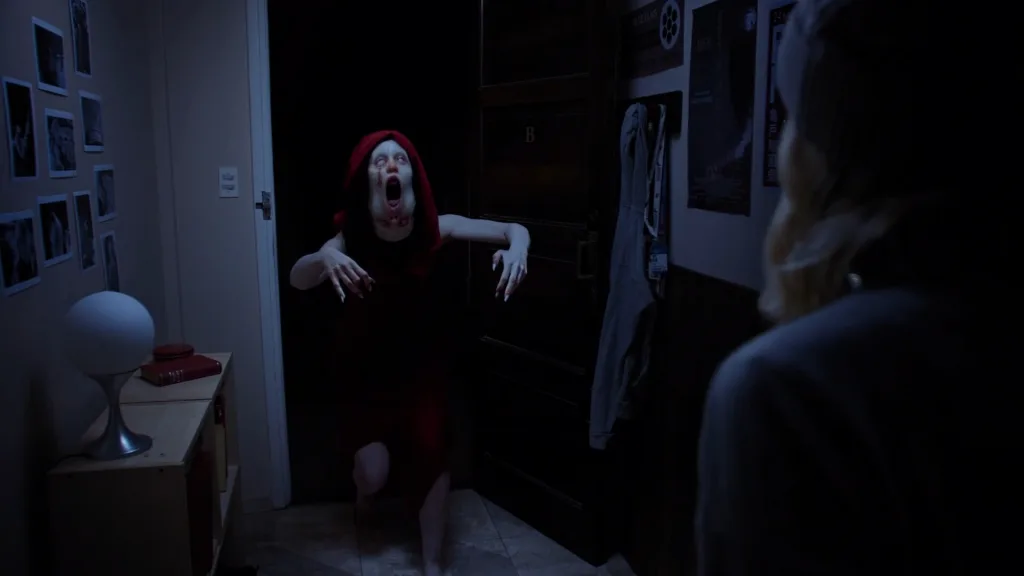
Tenebris Somnia, a 2D survival horror game from Argentine filmmaker Andrés Borghi and Saibot Studios, launched on 16 October 2026, with key story moments that switch from 8- and 16-bit pixel art to live-action film. It is published by New Blood Interactive, the publisher of DUSK and Blood West, and is available on Steam and on Xbox Series X|S and PC through Xbox Play Anywhere, according to an Xbox Wire post written on launch day by the game’s executive producer, Airdorf.
The player controls Julia, who goes to her ex-boyfriend’s apartment after nightmares in which he is attacked by monsters. The structure follows classic survival horror, with puzzles, limited resources and boss fights, and the Steam page compares it to Silent Hill and Resident Evil. According to Airdorf, cutscenes are tied to gameplay, so the player does not know when the game will switch to film or back.
Actors, prosthetics and a 17th-century cathedral
The cutscenes were shot with actors in real locations and a professional camera crew. Borghi storyboarded and directed them, edited the footage and worked on visual effects, Airdorf writes. Argentine actress Clara Kovacic plays Julia. Practical monster effects were supervised by Marcos Berta, whom the post credits with an award for his work on the Argentine horror film When Evil Lurks. Scenes were filmed in a 17th-century Argentine cathedral and on a subway, and sets were built to match locations in the game, combining practical set dressing with CGI. Silicone masks and prosthetics were moulded from performers’ faces and then applied with makeup, a process that took several hours each time.
Nearly four years, and no generative AI
Airdorf says production took nearly four years, and states that “absolutely no generative AI was used anywhere at any point in production”. Art and animation were drawn by hand, the music was composed by people and the translations were made by people. The Steam page lists full audio, interface and subtitles in English, Spanish (Spain and Latin America), Japanese and Brazilian Portuguese.
Rather than being an interactive film, Tenebris Somnia uses film as a sudden break in a pixel-art game, drawing on the practical-effects skills of Argentine horror cinema. It is also a Latin American project released through an established Western indie publisher, and its producer’s explicit no-AI statement shows that how a game was made is now part of how it is marketed.
Price and early reviews
On Steam the game costs €19.99, with a 20% launch discount until 30 October. The Xbox Wire post shows $24.99 and a $19.99 price. On 17 October, Steam reviews were “Very Positive”, with 95% of 64 user reviews positive, an early sample. A free demo has been on Steam since September 2023. GameTales has not played the full game.