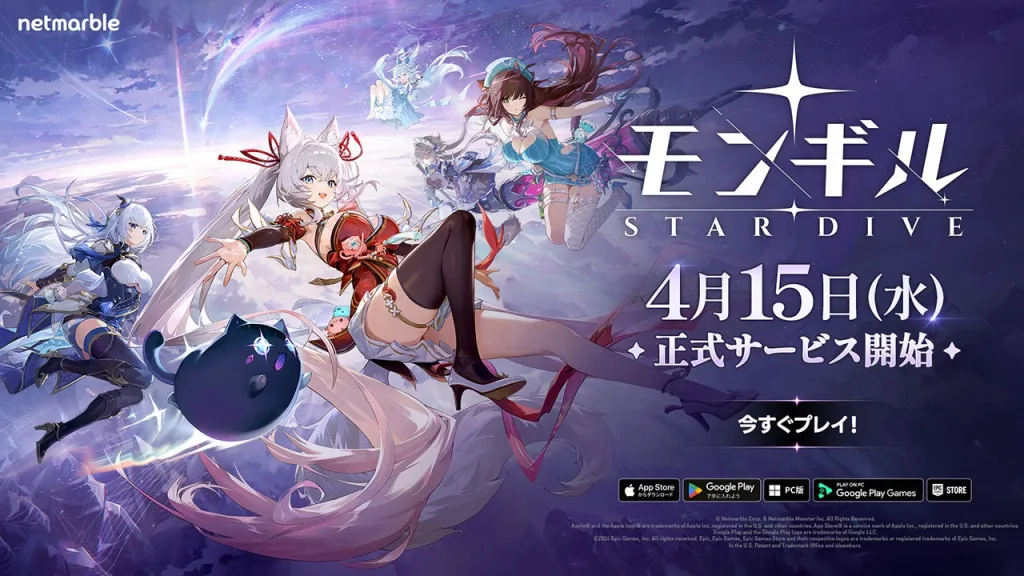
Netmarble Monster’s character technical art director Won Chul Ahn told Unreal Fest Tokyo how the studio reshaped the anime look of MONGIL: STAR DIVE in its last months before launch without modifying Unreal Engine or its G-Buffer layout. The talk, held at the 3–4 November event in Ariake, Tokyo, under a title that translates as “MONGIL: STAR DIVE anime-style look: beyond polish, towards appeal”, was written up on 5 November by Game Makers. All details of the session below come from that report.
MONGIL: STAR DIVE is a free-to-play monster-taming action RPG built in Unreal Engine 5. It launched worldwide on 15 April 2026 on iOS, Android and PC, through the Epic Games Store and the Netmarble Launcher, according to Netmarble Japan’s launch release. Ahn came to games from film production and game cinematics, and worked as a technical artist at Nexon and Line Up on several anime-style projects before joining Netmarble Monster.
Less than six months, finished assets and a PBR shader
When Ahn joined, release was less than half a year away and a large volume of models and textures had already been made. The project used its own physically based custom shaders, which gave little control over a stylised look. Redoing the assets was not an option, so he set three limits: no changes to the engine or the G-Buffer layout, only small edits to the existing custom shaders, and as few asset changes as possible.
Hair, eyes and eyebrows solved in the material graph
- Hair kept its anisotropic specular highlight. Ahn tinted it with the skylight colour so it sits with the sky and background, and removed redundant mask and texture reads. A pseudo-light, the dot product of the hair normal and a virtual light direction, adds volume without depending on real lights or shadows.
- Eyes have a highlight that moves in a camera-relative coordinate system, and BumpOffset makes the pupils look recessed.
- Eyebrows are pulled in front of the fringe with a CameraOffset node feeding World Position Offset, instead of semi-transparent bangs or a G-Buffer redraw. A second, semi-transparent set of brows keeps the expression readable both where the hair covers them and where it does not.
- Lips get gloss from a specular term built on the normal and half vector, masked to part of the lip. The half vector is weighted less towards the view direction to stop the highlight sliding as the camera moves.
Normals from one channel, tights and fur
To avoid new normal maps, Ahn derived simple normals from a single-channel texture with DDX and DDY and a constant third component. One texture can yield three normals from its R, G and B channels, with alpha as a mask; the report says this works best on materials with sharp boundaries.
Tights and stockings use anisotropic specular built from the tangent and a half vector biased towards the view. Their sheerness changes with the angle between normal and view, and knee bend is passed from Blueprint to the material through Custom Primitive Data and combined with a mask, so the fabric thins as the knee flexes. Animal fur stacks several BumpOffset layers to vary length and density; Parallax Occlusion Mapping was too expensive.
Outlines drawn in post-processing, with a mobile cut-down
Outlines come from a Laplacian filter on custom-depth edges, drawn on the inside of silhouettes so dithered, see-through areas do not get heavy lines. Boundaries between parts of a character use per-part roughness values read through SceneTexture, together with stencil values and shading model IDs. Line colour follows scene colour and base colour, thickness is adjusted by depth and field of view, distant characters get no outline, and spherical objects are flagged by stencil to avoid false lines. On mobile, where SceneTexture is unavailable and the budget is tighter, only the outer silhouette is outlined.
Characters lit apart from the scene
The skylight is switched off on characters because it did not suit the toon look. Instead, the SkyLightEnvMapSample node samples a colour from the skylight cubemap and overlays it on the base colour so characters still match the background. Background glass avoids translucency problems by using a Scene Capture cubemap with a custom reflection vector.
What Substrate’s Toon BSDF still lacks for faces
Ahn also tried the Toon BSDF introduced experimentally with Substrate in Unreal Engine 5.8. He found it fairly easy to use, and it works with the existing light system without engine changes. Shaping facial shadows as intended remained difficult: with a facial SDF approach he lacked a shadow attenuation control, which the report says suggests engine changes would still be needed for that part.
Ahn described three directions in anime-style games: overwhelming quality, an art style that otaku fans like, and a unique world and mood. He argued that deciding what to express matters as much as how to build it, and that work with AI tools goes better when the analysis and plan are clear, not just when tools or features are named.
On 5 November, the day the report appeared, Netmarble presented its third-quarter results. On the earnings call, chief executive Kim Byung-kyu said the launch results of MONGIL: STAR DIVE and The Seven Deadly Sins: Origin showed clear room for improvement, and that pushing several platforms at once can sometimes cost more than it gains, GameMeca reported. In Netmarble’s third-quarter revenue breakdown, the game’s share was too small to be listed separately.