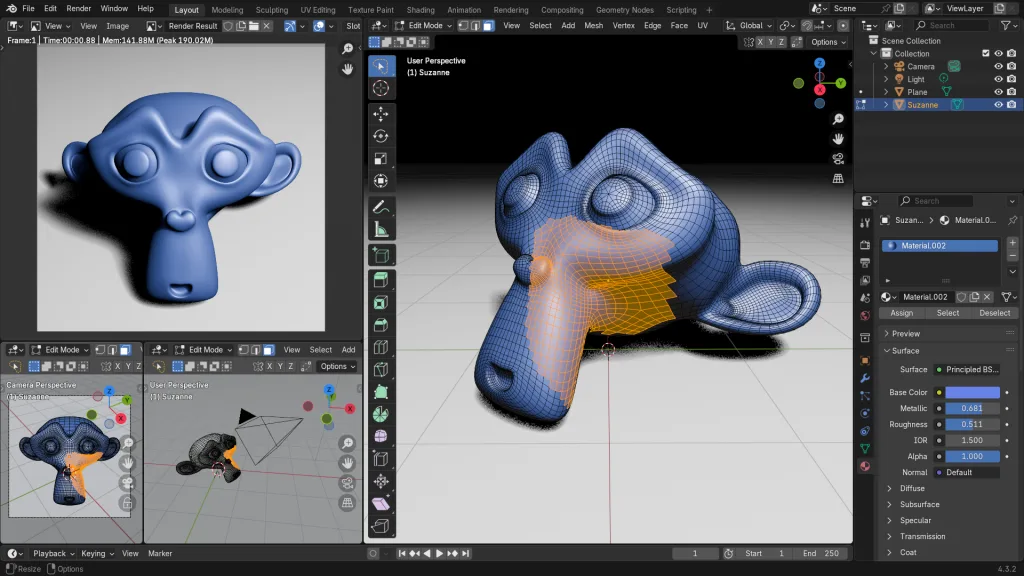

Tokyo 3D artist Hirokazu Yokohara has had AI agents build a detailed interior scene in Blender without operating the program himself, and then move it into Unreal Engine 5. On 9 October he posted the Blender scene on X as a work-in-progress test: no touching Blender by hand, AI only, modelling included, with several methods combined to push the quality. The clip has passed 720,000 views.
On 20 October he followed with a looping version of the room running in UE5. According to Shazoo, which brought the story to Russian readers on 27 October, Yokohara used OpenAI’s GPT-6 Astra and Anthropic’s Claude Opus to build the Blender scene and Opus alone for the port to Unreal. He described the move into a game engine, normally the painful step, as easy with AI, and floated making a small horror game in the room.
Six weeks of public agent tests
Yokohara is a generalist who works in Cinema 4D, Maya, ZBrush and UE5; 80.lv covered his semi-realistic UE5 virtual human in 2024. He has been testing agents in the open since GPT-6 Astra launched on 3 September.
- 6 September: he gave Astra an image and had it model a street backdrop in Blender and cut the breakdown video. The quality was “still no good,” he wrote, but it felt like “the beginning of an era when 3DCG is not made by human hands.”
- 20 September: he skipped AI 3D generators on purpose and had Astra sculpt in Blender step by step, as a person would. He briefed it in detail, as he would a new colleague, ran it at the highest effort setting, and found the result cleaner than he expected.
- 9–20 October: the AI-only room in Blender, then the UE5 version.
What the clips do not show yet
Yokohara has not published prompts, timings, costs or project files, and neither scene is available to download. Taiwan’s AI郵報 pointed out on 11 October that his posts do not list every tool, how long each step took or how failures were fixed. It also noted that a polished render is not yet a scene a studio can hand to a level designer: object hierarchy, naming, materials and performance still need checking.
“Without touching Blender” describes who operated the software, not who made the decisions. Yokohara chose the brief, judged every pass and sent the corrections. The agents saved him the clicks, not the art direction.
English threads filled in the gaps
In English the story has spread mostly through reposts. An X thread on 18 October, seen by about 78,000 people, laid out an eight-step method for building the room with Opus through Blender MCP, with a Tripo 3D-generation step for complex props. Those steps are the poster’s reconstruction, not Yokohara’s own write-up.
OpenAI’s Astra architecture demo follows a similar route: the model builds the scene through Blender’s Python API and exports it to Unreal. OpenAI itself notes that some shader behaviour “was approximated”, so matching the look “still required inspection”.
For game teams this is still a prototyping story: an agent ran Blender and Unreal, and an experienced artist decided what the room should look like. Engine makers are seeing the same shift in their own tools. Unity says agents and automation now run 98% of its CLI commands.
Disclosure: GameTales drafts its articles with AI assistance, including Anthropic’s Claude, one of the models named in this story.