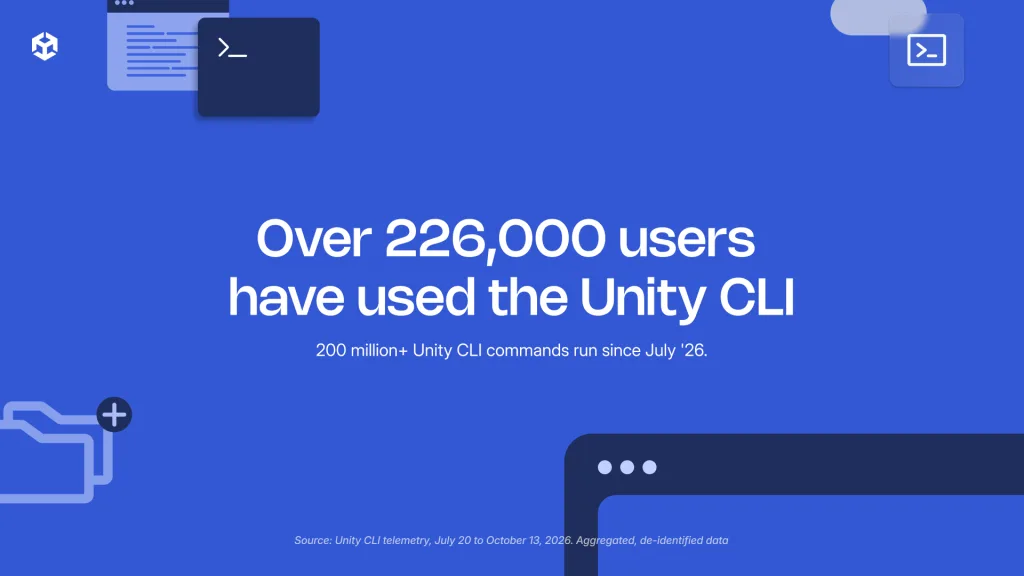
About 98% of Unity CLI runs between 20 July and 13 October 2026 came from coding agents and other automation, Unity said on 22 October. In a post on Unity’s blog, senior software developer Christopher Addison reports more than 200 million events, most of them command runs, from more than 226,000 signed-in users over the period.
0.2% of commands typed by people
The split by who ran the commands is lopsided:
- coding agents and other automation: about 98%;
- CI pipelines: 0.3%;
- people typing in a terminal: 0.2%;
- a small remainder that fits none of these groups.
The most used command by far was “unity command”, with about 124 million runs, followed by “unity status” with about 6.7 million and “unity pipeline list” with about 1.4 million. Among identifiable agents, Unity names Claude Code as the most active, followed by Codex, with Cursor and Grok in the next group. The rest comes from scripts and tools that do not identify themselves. By country, the United States, Japan and South Korea were the largest audiences among signed-in users, followed by Germany.
What the 98% actually counts
Unity says the data comes from aggregated CLI telemetry, excludes Unity employees and developers who opted out, and counts each event once so that retries do not inflate totals. A run counts as a person only when both input and output are a terminal, and as CI when a CI environment variable is present. Runs in MCP mode, runs from a known AI tool and other piped or scripted runs are all grouped together as “agents and automation”.
That last group is broad. A developer’s own shell script that pipes output lands in the same bucket as an AI coding agent, so the 98% is best read as “not a human at an interactive terminal” rather than as a precise AI share. The post does not give separate totals for each agent, does not break the data down by operating system or Editor version, and does not say how much of the activity comes from Unity’s own plugins.
From agent plugins to agent traffic
Over the past two months Unity has shipped official plugins for coding agents, starting with Claude Code in September, then Codex, and most recently Grok Build. We covered the first two in our August–September and September–October roundups. The new figures are the first public indication of how the tool is actually used: the terminal has become an interface for agents far more than for people.
For studios, agents are now a large share of the traffic hitting engine tooling, which makes predictable command output, clear errors and safe defaults more important than features designed for someone reading a terminal. The figures cover only signed-in CLI users who did not opt out, so they say nothing about how many Unity developers use agents overall.
Disclosure: GameTales uses Claude Code, an Anthropic product named in Unity’s data, for research assistance. Anthropic had no involvement in this article, which is based only on Unity’s published post.